
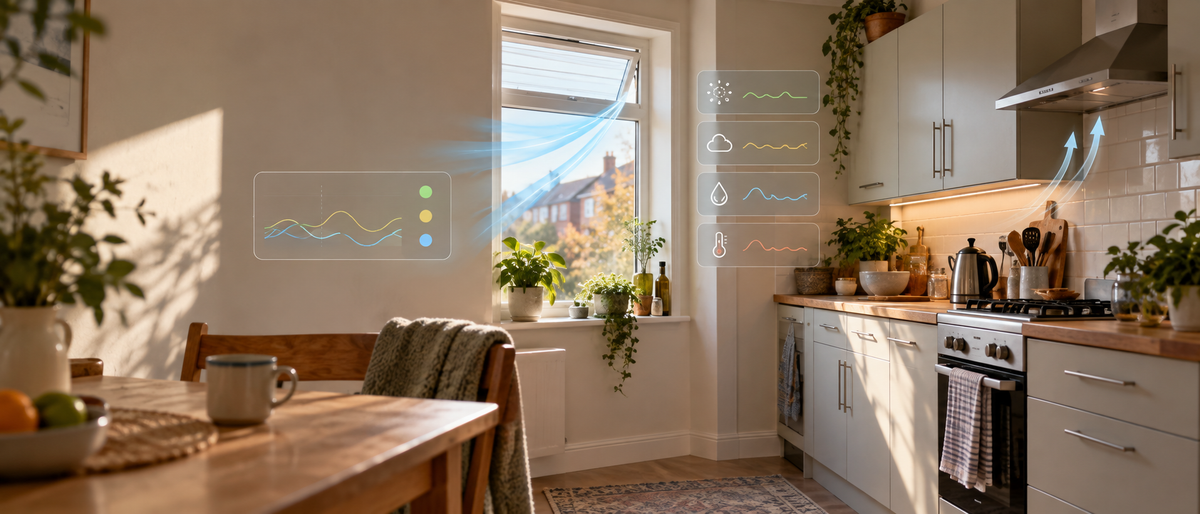
From ULEZ to classroom filtration, air quality policy is increasingly moving beyond measurement towards intervention. But in the home, where outdoor pollution, cooking, moisture, ventilation and everyday activities all influence the air people breathe, the path from understanding the problem to doing something about it is less clear.
Indoor air quality (IAQ) is moving steadily up the public-health agenda.
In August, new research published in The Lancet Public Health linked improvements in London's air following the introduction of the Ultra Low Emission Zone with improved lung growth in children. In September, Healthy Indoor Air in Schools: Every Breath Shapes Learning, a high-level event held at UN Headquarters during the UN General Assembly, brought governments, scientists and public-health specialists together to discuss indoor air quality, including practical approaches to air cleaning and monitoring.
In London, that transition from understanding exposure to actively reducing it can already be seen in schools. The Mayor's School Filters Programme is investing £2.7 million to provide HEPA filtration to at least 200 schools across every London borough, alongside monitoring, maintenance and education.
That is an important development. But children leave school at the end of the day - what happens when they go home?
Outdoor air does not stop at the front door
We have traditionally separated outdoor and indoor air quality into different conversations, but the boundary between them is less distinct. Outdoor particulate pollution can enter buildings, while activities taking place inside the home can contribute to additional sources of exposure.
We witnessed this in our office using an AirGradient indoor monitor and a solar outdoor monitor on the roof. Changes in indoor PM2.5 broadly followed what was happening outside, with occasional indoor peaks that had no corresponding outdoor event.
Monitoring alone doesn’t tell us the source of every particle but paired indoor and outdoor measurements can help us build a much clearer picture of how indoor concentrations relate to conditions outside, where the patterns differ, and how those relationships change over time
So what are the likely sources of indoor air pollution? Wood burning, cooking and chemical sprays all contribute to the quality of the air in our homes. The UKRI-funded INGENIOUS programme, which studied indoor air pollution in more than 300 homes in Bradford, found substantial variation between homes but peak PM2.5 concentrations were frequently driven by cooking.
We conducted a survey into kitchen extractor usage with 106 participants and found low awareness that cooking generates harmful pollutants. We also found low confidence in extractor performance and usage, with participants citing reasons such as “Too noisy”, “Hard to clean”, and “Not effective”.
Education is a low-cost approach but there are circumstances when advice is not always practical. For social housing providers, indoor air quality sits within a complicated relationship between the building, its systems, the outdoor environment and the people living there.
Damp and condensation are particularly challenging in social housing. Moisture is generated through normal everyday activities such as cooking, washing and drying clothes. Temperature and ventilation can influence whether that moisture remains manageable or contributes to condensation and mould.
Resident advice often includes opening windows, using extractor fans and maintaining adequate heating. In principle, these are sensible measures. However, telling somebody to heat their home more assumes that they can afford to do so. Asking them to open windows during winter may mean choosing between ventilation and thermal comfort.
That raises a wider question for housing providers: how much should healthy indoor air depend on a resident being able or willing to change the way they live?
IAQ is also about health, not simply buildings
The consequences of poor indoor conditions are sometimes discussed primarily in terms of the building: mould growth, damaged decor, deterioration of walls and the cost of remedial works. But what do these conditions mean for the people living there?
Government guidance states that damp and mould primarily affect the airways and lungs, with children, older people and people with existing health conditions at greater risk.
A home with repeated high humidity, poor ventilation or increased particle concentrations may represent a maintenance risk, but it may also be occupied by somebody for whom those conditions carry a greater health consequence.
That makes the case for identifying risk earlier and, where possible, addressing the underlying conditions before they develop into a complaint or visible problem.
From remediation to earlier intervention
Social landlords understandably have to prioritise properties with severe damp and mould. Awaab's Law places clear timescales around investigating and addressing significant hazards.
Some councils and housing providers are now trying to move further upstream. Environmental sensors are being used to identify homes at risk of damp and mould before residents report visible problems, while other programmes are combining monitoring with measures such as improved ventilation, heating and energy-efficiency works.
This distinction between remediation and intervention may become increasingly important. Remediation asks how quickly we can respond once mould has appeared. Intervention asks whether we can prevent the conditions from developing in the first place.
Monitoring has an important role in that process, but monitoring itself is not the intervention. Knowing that a home repeatedly reaches conditions associated with condensation, or that particulate concentrations rise sharply during particular activities, is only useful if that information leads to something being done.
Education is essential. People should understand what affects the air inside their homes and what they can realistically do to improve it. But education places much of the responsibility on the person living in the property.
Could intervention be designed into the home itself?
The opportunity now is to think more carefully about what intervention can look like inside the home.
In many properties, measures intended to manage moisture and pollutants are already present. The difficulty is that their effectiveness can still depend heavily on resident behaviour: switching extraction on, opening windows, maintaining heating or changing everyday habits.
If the solution depends on repeated action from the resident, that creates a fundamental limitation.
The alternative is not simply to add more ventilation or more advice. It is to ask whether some aspects of indoor air quality control can be designed to work independently of behaviour by responding to conditions in the home, operating automatically where appropriate, or dealing with pollutants and moisture closer to source.
That shifts the conversation from telling residents what they should do towards considering what the home itself can do.
None of these approaches removes the need for education, and no single intervention will suit every home. But there is a significant difference between giving residents information and creating homes that are better able to manage the conditions that affect indoor air quality in the first place.
As monitoring becomes more widespread and our understanding of indoor air improves, the challenge for housing providers may therefore be less about gathering more data and more about deciding what action that data should trigger.
This means not simply asking ‘what is in the air?’ but ‘what can we practically do about it before it becomes a problem?’
If you work in social housing and are looking at practical ways to move from monitoring indoor air quality to intervention, we’d be interested in hearing from you. Airbon is developing integrated approaches to particle pollution and condensation-related mould that are designed to work within existing homes and retrofit programmes.
Get in touch to discuss what you are seeing across your housing stock.
Share:
Why we created the Aura series: clean air designed to belong in your home